Troubleshooting EDF Jets for Hobbyists: Ducted Fans, Power-to-Weight, Foam Reinforcement and Safe Launching.
Troubleshooting EDF Jets for Hobbyists: Ducted Fans, Power-to-Weight, Foam Reinforcement and Safe Launching.
Electric ducted fan jets are rewarding but unforgiving models that combine compact propulsion with airframe sensitivity, and this guide focuses on practical troubleshooting for hobbyists who want to avoid common traps and keep flights safe and enjoyable.
Ducted fan specific issues are often the root cause of strange noises, excessive vibration and sudden loss of thrust, and the first checks should always be physical inspections for sucked-in debris, cracked impeller blades and rubbing between the rotor and stator housings.
Vibration usually indicates imbalance or a loose mount, and you can diagnose it by gently spinning the fan by hand to detect wobble, checking the motor bell for play, and confirming the backplate is fully seated with no play between the fan and the ducting.
Power-to-weight miscalculations show up as poor acceleration, short climb and overheating, and the correct approach is to measure static thrust against model weight to get a realistic thrust-to-weight figure and to verify battery voltage and current draw under load with a wattmeter.
If the current draw is higher than expected or the ESC gets hot, reduce pitch or switch to a battery with higher C rating or capacity, and consider trimming weight from non-structural components before uprating the motor so you do not compound thermal problems.
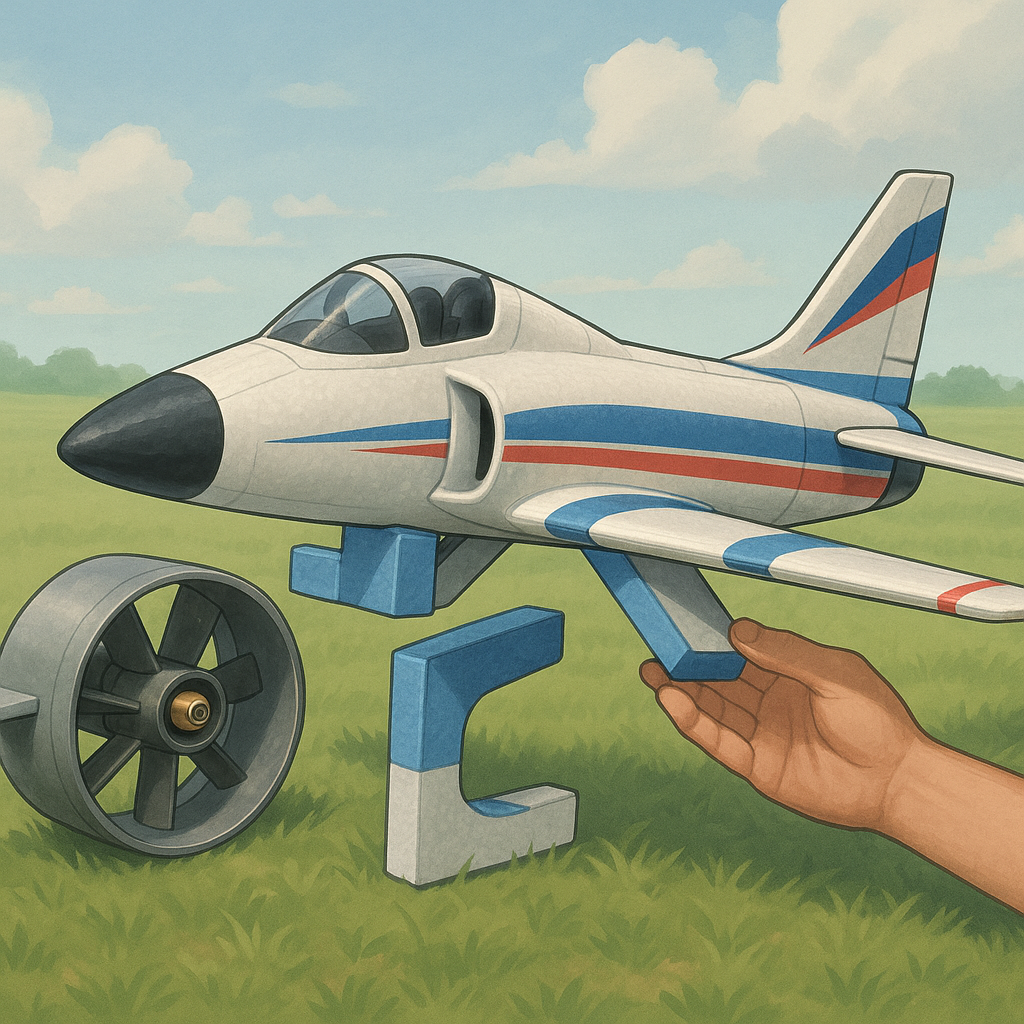
Foam airframes need local reinforcement where the ducted fan and landing loads concentrate, and common solutions include glass cloth with epoxy over critical bulkheads, carbon fibre rods in the fuselage spine, hardwood spars for wing roots and 3D printed or hardwood motor mounts bonded with foam-safe adhesives.
Repairs to crushed or torn foam are straightforward when caught early, and patches reinforced with epoxy and microballoon fillet will arrest propagation of tears while adding little mass to the airframe.
Safe launching is as much about setup as it is about technique, and always confirm the centre of gravity, control throws and failsafe before applying full throttle for a launch so that any trim or mechanical issues appear at low energy levels rather than during a high-speed climb.
Hand launching an EDF requires a confident, level toss with a modest climb attitude into wind, and if the model tends to drop the nose check thrust line and elevator centring because excessive downthrust, tail-heavy balance or delayed motor spool can all produce that behaviour.
A simple pre-flight checklist will save many flights, and you should run through airframe integrity, fan free-spin, secure battery straps, ESC telemetry and radio range checks each session to catch issues before takeoff.
- Inspect intake and exhaust for foreign objects and damage.
- Verify motor mount and fan seating are rigid and free from play.
- Measure idle and full-throttle current to detect overdraw or battery sag.
- Confirm centre of gravity and control surface movement and alignment.
For build templates, reinforced foam techniques and example motor mount designs that can speed up repairs and upgrades, see the collection of guides at WatDaFeck which include practical photos and part lists to help you reproduce reliable fixes.
Final tips are to log problematic flights, inspect the fan after any rough landing, run a low-power spool test after repairs and always fly with a spotter and safety gear when testing new configurations or higher power setups.
Follow me on: Facebook: https://www.facebook.com/watdafeck3d · Instagram: https://www.instagram.com/watdafeck3d/.
Comments
Post a Comment