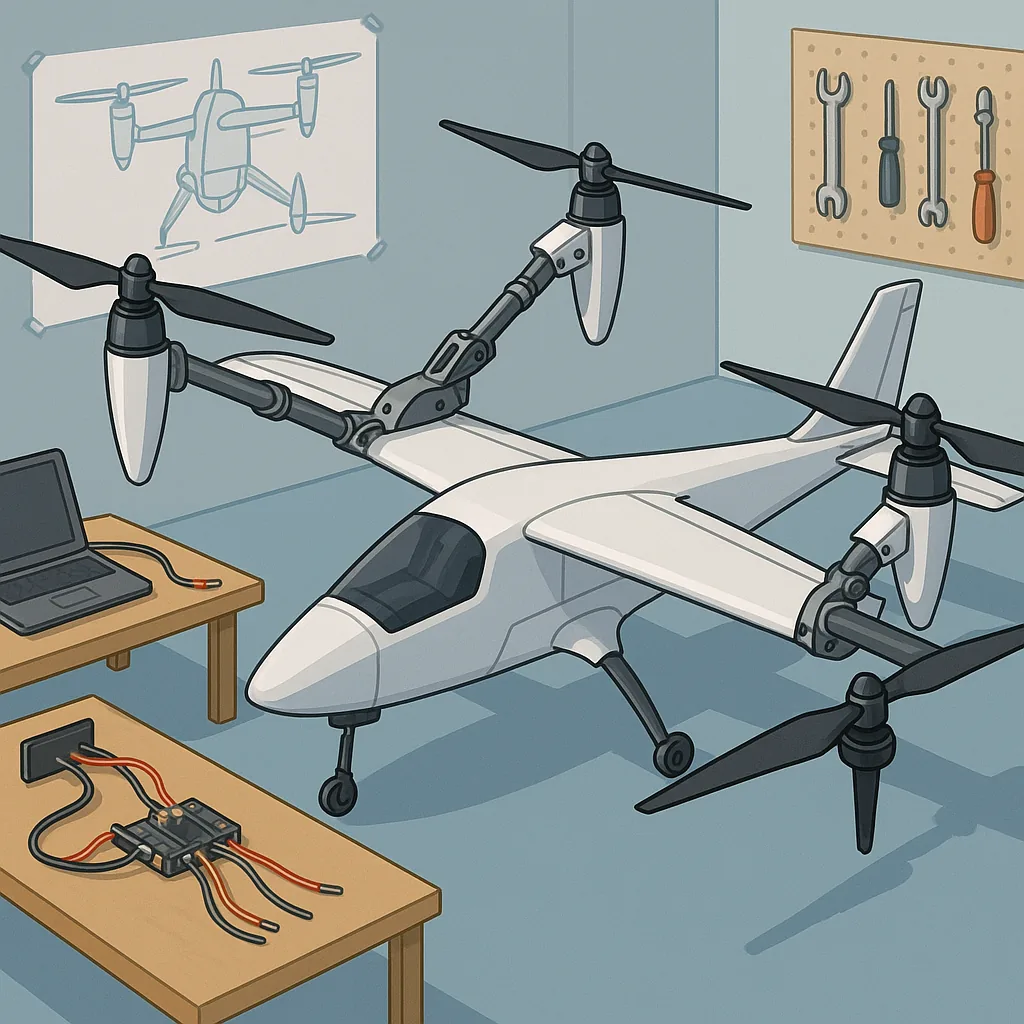
VTOL for Hobbyists: Practical Tips for Transition Programming, Tilt Mechanisms and Wiring
Building a VTOL for hobby use is immensely rewarding and also technically demanding, so a few practical tips will save hours of frustration during test flights and tuning. Focus early on software modes and hardware interactions so you understand how transitions are effected by both programming and mechanical behaviour. This guide concentrates on transition programming, choices between iNav and ArduPilot, tilt mechanism best practice, and wiring tips that reduce electromagnetic and power issues. The idea is to get you flying safely while still leaving room for fine tuning and upgrades.
Transition programming is the heart of a good VTOL experience and it pays to adopt an incremental approach to changes in the transition logic. Start with gentle blends between hover and forward flight by lengthening the transition time and reducing servo rates so the aircraft cannot flip quickly during early tests. Use throttle and pitch curves to avoid sudden thrust jumps, and employ a dedicated RC switch to engage transition modes so you can abort quickly if something feels off. Log every flight and compare the control inputs to the autopilot outputs to identify oscillations or mismatched control authority.
Choosing between iNav and ArduPilot often comes down to project complexity and mission goals, and each firmware has strengths for hobby VTOLs. iNav is straightforward for simpler tiltrotors and multi-rotor-to-fixed-wing blends and tends to be lighter on configuration for straightforward lifts. ArduPilot is richer for advanced VTOL behaviours, waypoint transitions and redundant sensor setups, but it can require more parameter work to get smooth blends. Whichever you pick, ensure you run software-in-the-loop or hardware-in-the-loop tests where possible and keep firmware updated with changes documented so you can roll back if a parameter change causes unexpected behaviour.
Tilt mechanisms demand careful mechanical design because sloppy linkages lead to poor transition trim and inconsistent control feel. Use metal-geared servos or digital high-torque units for any tiltservo that carries propeller loads, and fit proper bearings and anti-rotation links to stop twist in the arm. Synchronise multiple servos with a mechanical linkage or mirrored electronic control so both tilting assemblies move identically, and include a reliable neutral stop or lock to hold geometry if a servo fails. Keep the centre of gravity low and, where practical, trial a small counterbalance on the tilting assembly to reduce servo load during aggressive transitions.
Wiring is often overlooked until it causes a mid-air problem, so plan the power distribution and signal routing with redundancy and EMC suppression in mind. Use a primary power bus for ESCs and a separate, fused supply for servos and the flight controller where possible, and invest in decent-quality bullet connectors and rcfans for high-current runs. Keep telemetry and compass wiring well away from high-current ESC and motor leads, use twisted pair signal wiring for long runs and add decoupling capacitors close to ESC power input to reduce voltage spikes. Fit a current sensor and smart BECs so you can monitor consumption in flight and prevent brownouts during a heavy transition phase.
- Preflight checklist: control throws, failsafe positions, tilt servo centring, battery health and GPS lock.
- In-flight discipline: use conservative transition speeds on early flights and log everything for post-flight analysis.
- Maintenance: check linkages and wiring harnesses after any rough landing and replace fatigued components before the next flight.
Finally, practise transitions progressively and rely on log analysis to guide parameter tweaks rather than guesswork, and don’t hesitate to ask the community for help when a behaviour looks odd for your airframe. If you want build notes or parts lists from the projects that informed these tips you can find them on my site at WatDaFeck. Keep a flight journal that records environmental conditions, exact parameter sets and any mechanical changes so successful configurations can be replicated reliably.
Follow me on: Facebook: https://www.facebook.com/watdafeck3d · Instagram: https://www.instagram.com/watdafeck3d/.
Comments
Post a Comment