Beginner's Guide to RC Helicopters: Collective Pitch, Flybarless Controllers and Tail Tuning
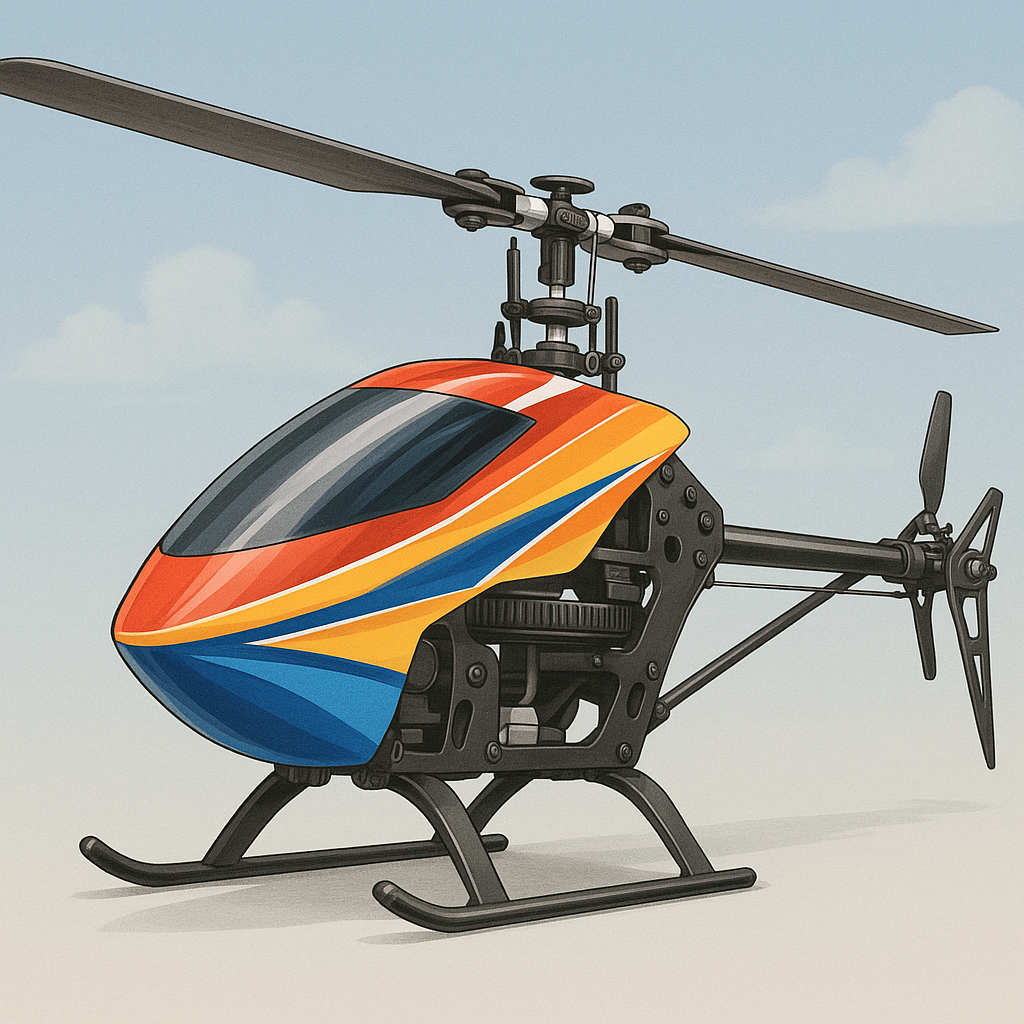
Getting into RC helicopters is hugely rewarding but also a steep learning curve compared with multirotors, because RC helicopters combine mechanical complexity with precise pilot input and delicate tuning. Beginners should understand there are both fixed-pitch trainers and collective-pitch machines, and the latter allow much greater control and manoeuvre potential at the cost of requiring setup and tuning knowledge. This guide focuses on the parts of that learning curve that cause the most confusion for new pilots: collective pitch systems, modern flybarless controllers, tail tuning and sensible beginner setups for safe progression.
Collective pitch is the system that lets you change all rotor blade pitch together to produce lift and allow inverted flight, unlike fixed-pitch rotors where lift is altered only by rotor speed. In a collective-pitch model the swashplate translates servo movements into cyclic and collective changes, so small inputs can produce large reactions and require smooth throttle and stick control. For practical advice on parts, build notes and suggested components you can also consult WatDaFeck where I document real examples and setup files that help bridge the gap between theory and flying.
Flybarless controllers have become standard on hobby helicopters and they replace the old mechanical flybar with sensors and software that stabilise the rotor head electronically. A flybarless controller typically includes a three-axis gyroscope and accelerometer with PID loops that correct head behaviour many times per second, allowing quicker responses and less mechanical complexity. The trade-off is that you now need to understand PID and gyro gain basics and be comfortable updating firmware or loading manufacturer default profiles, because a poorly configured controller can make the machine twitchy or unstable.
Tuning the tail is a separate discipline and it is vital for clean yaw control, especially on collective-pitch models where torque changes rapidly as you vary the collective. Start with a good quality metal-geared tail servo and a correctly sized tail rotor, and check the tail boom and linkage for play before adjusting electronic settings. On the flybarless unit you will typically set tail gyro gain, damping and possibly inertial compensation; tune gains progressively by testing on the ground and then with short hover checks, and avoid setting gains so high that the tail hunts or oscillates under load.
For beginners I recommend starting with a robust 450–500 class collective-pitch heli fitted with a modern flybarless controller that offers a beginner or stability mode, and ensuring the radio has dual rates and exponential available. Useful kit includes a quality LiPo battery with a smart charger, a simulator-capable transmitter to practise on your PC before risking the model, and a trainer or buddy-box option if you can fly with an experienced helper. Spend time trimming servo linkages and centring the swashplate at neutral before each flight, and keep flight sessions short while learning to make small, deliberate stick inputs.
Safety, patience and practice are the routes to progress with RC helicopters, and deliberate practice on a simulator will save many airframes and hard lessons. Always do pre-flight checks for rotor balance, secure hardware and correct rotor head timing, and carry spare blades, tail fins and linkages in your field kit. Join a local club or flying school where you can receive guidance, use a buddy-box for your first flights and learn the incremental approach to increasing collective authority and aerobatic capability while keeping both the model and bystanders safe.
Follow me on: Facebook: https://www.facebook.com/watdafeck3d · Instagram: https://www.instagram.com/watdafeck3d/.
Comments
Post a Comment