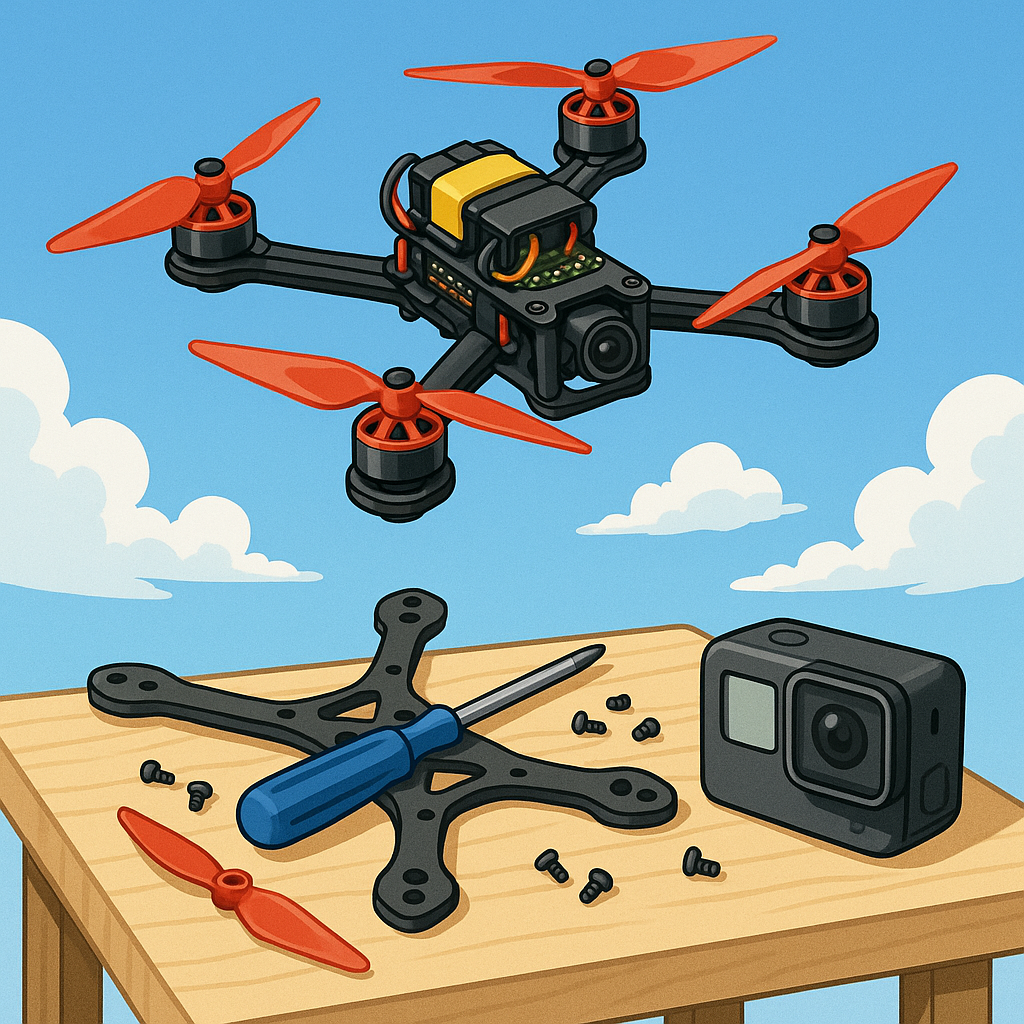
Freestyle drone project ideas for hobbyists: rates, propwash, frame stiffness and GoPro mounting.
Freestyle flying is all about personal expression with a quadcopter and the projects that grow your skillset usually focus on control and feedback rather than outright speed. This roundup lists approachable projects you can tackle at the bench and in the field, with an emphasis on rates tuning, propwash control, frame stiffness and GoPro mounting to get cleaner footage and smoother handling.
Start with rates tuning as a methodical project because rates determine how the quad responds to stick input and change the whole feel of a freestyle machine. Record a base flight profile and adjust one parameter at a time when you test new rates, keeping a simple log of roll, pitch and yaw multipliers plus expo so you can revert if something feels wrong. Use Betaflight or your flight controller configurator to store multiple profiles and run identical manoeuvres for comparison, and consider using a simulator to trial extreme values before risking a real crash.
Propwash control is the next natural project, because many freestyle pilots still wrestle with low-speed oscillations when the quad is pushed near full throttle or when passing through turbulent air behind the rotors. A practical experiment is to fly the same course with several propellers of different shapes and pitches, then compare the behaviour while altering D and P gains to find how the controller compensates for disturbed airflow. Add a soft mounting experiment to this project by printing and fitting different motor dampers or using arm micro-stiffeners to see how mechanical changes interact with PID settings.
Frame stiffness directly affects how the airframe transmits motor and prop forces into the flight controller sensors, so a build that measures stiffness is a high-value project for someone serious about freestyle control. You can set up a simple torsion test rig to compare different arm geometries and materials, and then 3D print reinforcing pieces in TPU or carbon-loaded filaments to trial on a donor frame. Keep notes on mass increase and flex under load, because the right compromise is a frame that is stiff in the yaw and roll axes but tolerates a little vertical flex to help absorb impacts.
GoPro mounting should be treated as both an aerodynamics and vibration control project because footage quality is the product of both camera stability and line of sight. Build several mounts with different durometer bushings and tilt angles to see how they affect both the vibration spectrum recorded by the camera and the pilot's ability to spot transitions. A small project to try is an angled TPU cradle with a lightweight carbon spacer that moves the camera slightly forward for a more cinematic horizon while keeping the centre of gravity stable, and test each mount with identical props and PID setups to isolate the mounting effects.
Use the following short list of practical projects as a starting point and expand them into longer series if one area sparks your interest, and for parts, build logs and more detailed step‑by‑step guides visit WatDaFeck.
- Rates tuning logbook: keep videos and notes to compare control feel across flights and rates profiles.
- Propwash comparison: fly an identical circuit with three prop types and document oscillations and recovery times.
- Frame stiffness experiment: print and fit braces to a test frame and measure effect on handling and vibration.
- GoPro mount series: prototype soft, semi-rigid and hard mounts and analyse footage for vibration and field of view.
- Filter and dynamic notch testing: monitor Blackbox logs to see how filter changes reduce motor whine and propwash response.
- Complete freestyle build: combine the best results from each project into a single tuned machine for filming and fun.
These projects are modular so you can pick one that suits your current skill level and workshop equipment, and each offers clear pass or fail results that make iteration rewarding. Keep flight logs, video recordings and controller dumps as you work, and remember that small, repeatable changes often beat big, rushed adjustments when you are tuning a freestyle quad for consistent behaviour.
Follow me on: Facebook: https://www.facebook.com/watdafeck3d · Instagram: https://www.instagram.com/watdafeck3d/.
Comments
Post a Comment