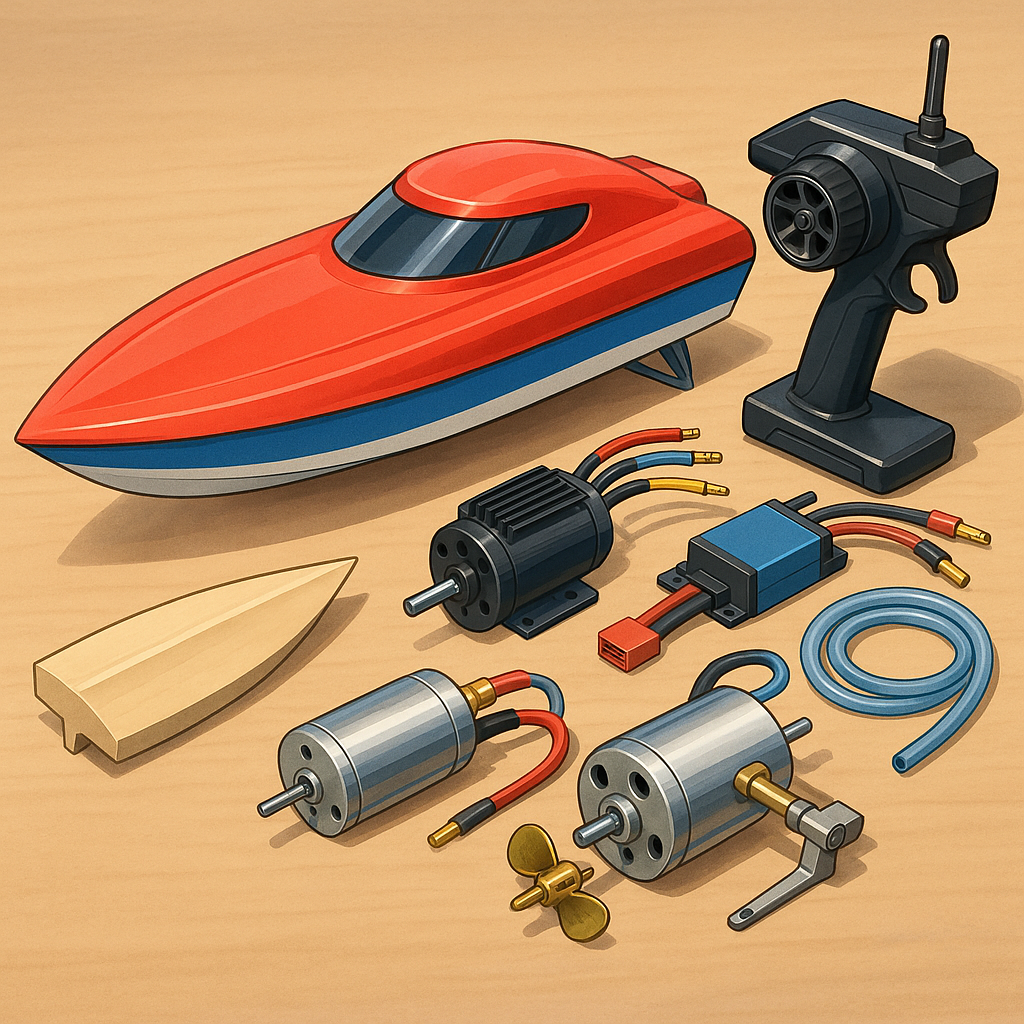
RC Boat Project Ideas for Hobbyists: Hulls, Motors and Cooling
If you enjoy building model boats, this roundup offers practical project ideas that focus on hull shapes, waterproof electronics, motor choices and cooling methods to get you on the water quickly and reliably.
Hull shape is the single most important choice for performance and handling, so pick a project that matches your goals and local waters. A deep-vee mono hull gives predictable handling in chop and is great for scale or sport boats, while a flat-bottom hydroplane suits high-speed runs on calm water and makes an exciting project for lightweight construction. Catamarans and tunnel hulls provide stability and top-end speed, and they reward careful weight distribution and alignment work during the build. Try a simple plywood or foam core mono for your first model and progress to a twin-hull catamaran for a faster second build.
Waterproof ESCs are worth their weight in gold for boat projects, but they come in a few different styles that affect longevity and maintenance. Fully sealed ESCs can be submerged and are convenient for casual users, while conformal-coated ESCs are protected against splashes but rely on careful sealing of connectors and cabling. For higher-power builds, consider an ESC with a separate waterproof housing and external cooling options, and always check the IP rating and continuous current capability against your motor and battery choice. Thoughtful cable routing and a well-sealed receiver box will prevent the most common failures in model boating.
The decision between outrunner and inrunner motors changes gearing, propeller choice and cooling strategy for your project. Outrunners deliver higher torque at lower gearing, making them excellent for propellers that need strong initial thrust, such as displacement hulls or heavy scale models, while inrunners spin faster and suit direct-drive or geared setups for sleek planing hulls. Inrunners often pair well with water-cooled jackets because their compact can allows easier jacket attachment, whereas outrunners can benefit from exposed aluminium bell housings and external air or water spray cooling. When choosing, match motor Kv and torque to your intended propeller pitch and expected battery voltage for efficient performance.
Cooling is the unsung hero of reliable RC boats and is particularly vital for ESCs and inrunners running continuous loads. Water cooling is the most effective solution and is commonly implemented with a simple pickup in the prop wash that feeds a water jacket around the motor or an ESC heat sink. Ensure pickups are located in unobstructed flow and that tubing is secure to avoid air locks that will dramatically reduce cooling efficiency. For sealed ESCs, consider adding a copper or aluminium plate as a heat spreader combined with exterior mounting in the bilge to exploit the boat's natural airflow when planing.
To tie these elements together, here are a few project pairings that work well and are achievable for hobbyists: build a deep-vee mono with an outrunner and sealed ESC for robust chop handling and simple maintenance; craft a lightweight hydroplane with an inrunner, geared drive and water-cooled ESC for sustained high-speed runs; or assemble a twin-hull racing craft with mid-power inrunners, a conformal-coated ESC and dedicated water jackets for efficiency and reliability. For parts lists, build notes and incremental upgrades that suit each of these ideas visit my site at WatDaFeck for step-by-step guidance and printable templates.
Follow me on: Facebook: https://www.facebook.com/watdafeck3d · Instagram: https://www.instagram.com/watdafeck3d/.
Comments
Post a Comment