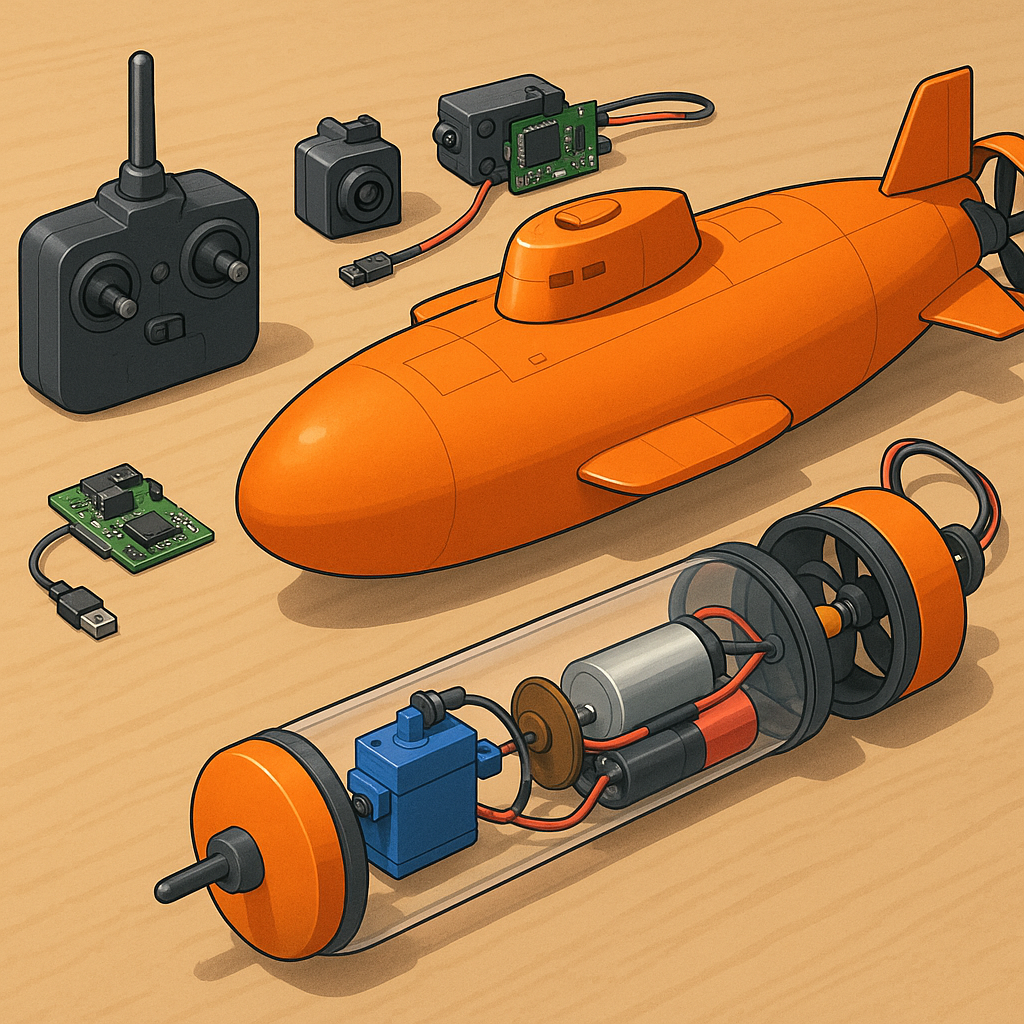
RC Submarine Project Ideas: Ballast, Fail‑Safe Surfacing, Waterproof Servo Bays and FPV Underwater
Building an RC submarine is one of the most rewarding projects for a maker who enjoys mechanics, electronics and a touch of marine engineering, and this roundup gives practical ideas to try at home with a modest budget and common tools.
Start with ballast systems because they define how your model behaves in the water, and experiment with three basic approaches: fixed ballast with trim weights for a stable scale model, variable ballast tanks using a small pump to admit or expel water, and piston or syringe actuators for precise displacement control in a compact hull.
For a hands-on project, build a simple variable ballast unit using a 12V bilge pump and a self-sealing tank, or craft a compact piston pump from 3D‑printed parts and a linear servo for quieter, more precise control, and fit a float sensor or pressure sensor for depth feedback as a next step.
Fail-safe surfacing is crucial and worth designing before you test at scale, so try these strategies to keep a boat from sinking: a spring‑released emergency ballast dump, an independent air bladder that inflates with a CO2 cartridge for emergency buoyancy, and battery-backed watchdog electronics that trigger surfacing if telemetry is lost or depth exceeds a safe threshold.
Waterproofing the servo bay is another area where practical projects pay off, and you can compare dry bays with sealed shafts, potted servos in resin for permanent waterproofing, and bellows or lip seal arrangements for removable servos, with each approach offering trade-offs between serviceability and robustness.
FPV underwater opens a new dimension but has physical limits, so try three FPV projects: a short‑range embedded camera with onboard DVR to recover footage, a tethered fibre or thin coax video feed with a surface relay for long runs, and a surface‑relay wireless transmitter that lifts the radio antenna above water for typical video ranges, and remember that lighting and low‑light sensors matter more underwater than above surface.
If you want parts lists, build notes and a few ready‑to‑print mounting templates for these ideas, check the project pages at watdafeck.uk for practical resources and community tips, and always test new buoyancy and fail‑safe systems in a controlled shallow pool before attempting open‑water runs to avoid damage or loss.
Follow me on: Facebook: https://www.facebook.com/watdafeck3d · Instagram: https://www.instagram.com/watdafeck3d/.
Comments
Post a Comment