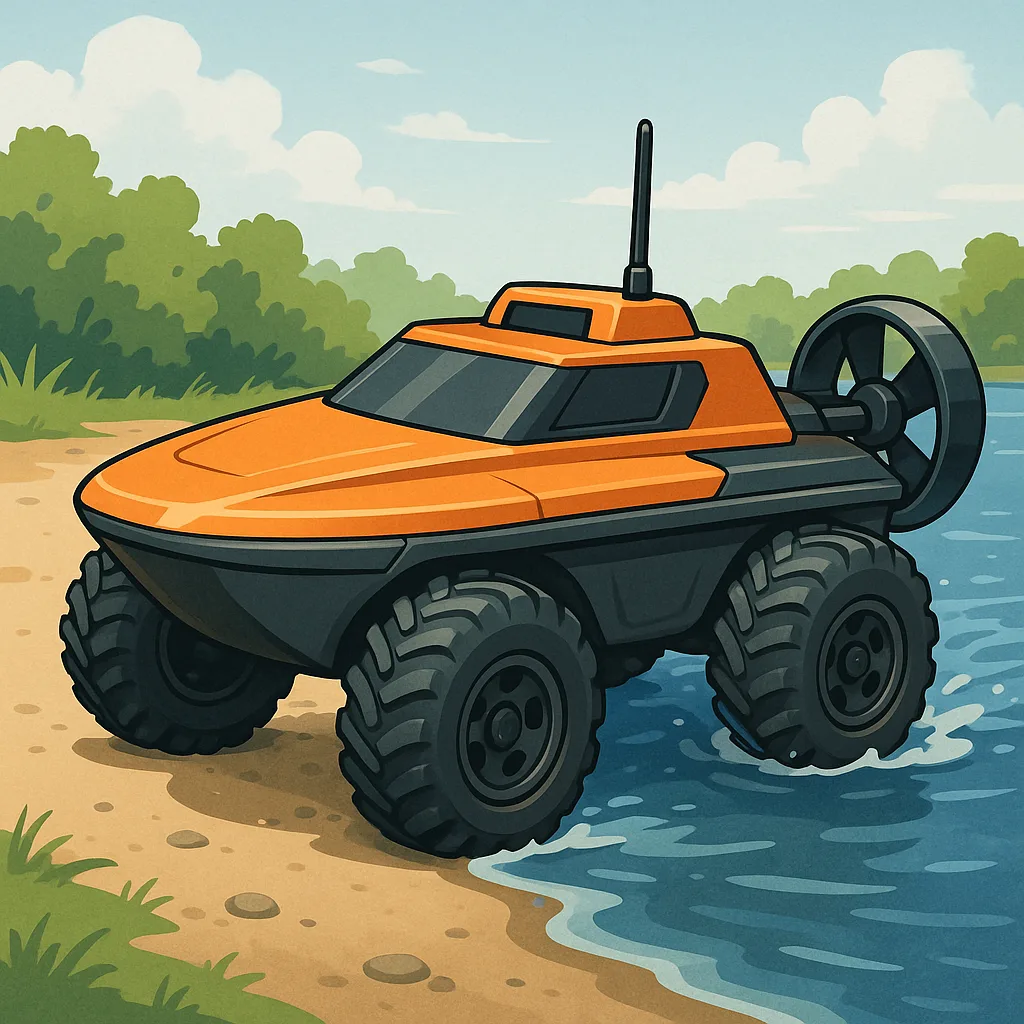
Amphibious RC Craft: Project Ideas for Smooth Water-to-Land Transitions.
Amphibious RC projects challenge hobbyists to think beyond a single environment and to design machines that can operate equally well on water and on land. This roundup collects ideas that emphasise water-to-land transitions, buoyancy considerations, sealing techniques, and mixed-terrain driving approaches. Each project notion below can be scaled to suit beginners or seasoned makers and is intended to inspire experimentation with hull shapes, drive systems and electronic protection strategies. The goal is to help you select a concept that matches your skill level and workshop resources while highlighting the practical problems you will enjoy solving during the build process.
Retractable-wheel boats make excellent first amphibious projects because they combine familiar RC car elements with simple boat hulls, and they force you to solve wheel-well sealing and buoyancy at the same time. Consider using servos to fold wheels into sealed wells, add removable wheel guards with flexible rubber lips, and install small drainage channels and a bilge pump for emergencies. Use closed-cell foam in cavities to ensure reserve buoyancy and design the wheel retraction so it does not compromise hull integrity. Attention to the wheel axle seals and a low centre of gravity will greatly improve transition stability when your craft beaches and then powers forward onto land.
For builders wanting more adventurous handling, tracked amphibious buggies and lightweight hovercraft are rewarding projects that explore traction and low-friction transition techniques. Tracked designs offer excellent traction on mud and shingle and can be paired with a streamlined hull so the tracks remain effective in shallow water, while hovercraft rely on a flexible skirt and a lift fan to glide over mixed terrain. Hovercraft skirts must be tuned for stiffness and leakage, and lift ducts require careful testing to avoid ventilation of water into electronics. Both approaches highlight different trade-offs between propulsion efficiency in water and manoeuvrability on varied surfaces.
Sealing electronics and managing buoyancy are the backbone of any amphibious build, and good practice saves grief during testing. Use bulkhead compartments for servos and receivers, fit rotary shaft seals or lip seals where prop shafts pass through the hull, and employ O-rings with silicone grease to improve longevity. Potting critical boards, using waterproof connectors and opting for pressure-equalisation vents that exclude water but allow air movement will reduce the risk of condensation and leaks. For practical build guides and parts recommendations check my project notes at WatDaFeck and consider keeping spare seals and a compact pump in your toolkit for field servicing.
Mixed-terrain driving demands attention to suspension settings, tyre or track choice and fine-tuning the centre of gravity to avoid nose-dives or capsizes during transitions. Use larger, lower-pressure tyres or wide rubber tracks for soft beaches, and consider a locking suspension system that can be stiffened for land and softened for water runs to maintain hull trim. Thrust vectoring with small rudder pods or variable pitch props helps correct course during the critical phase when part of the craft is supported by both water and ground. Always test near shorelines with gradual ramps and have a recovery plan such as a buoyant tow line and a spotter to shorten recovery times and protect your investment.
Comments
Post a Comment