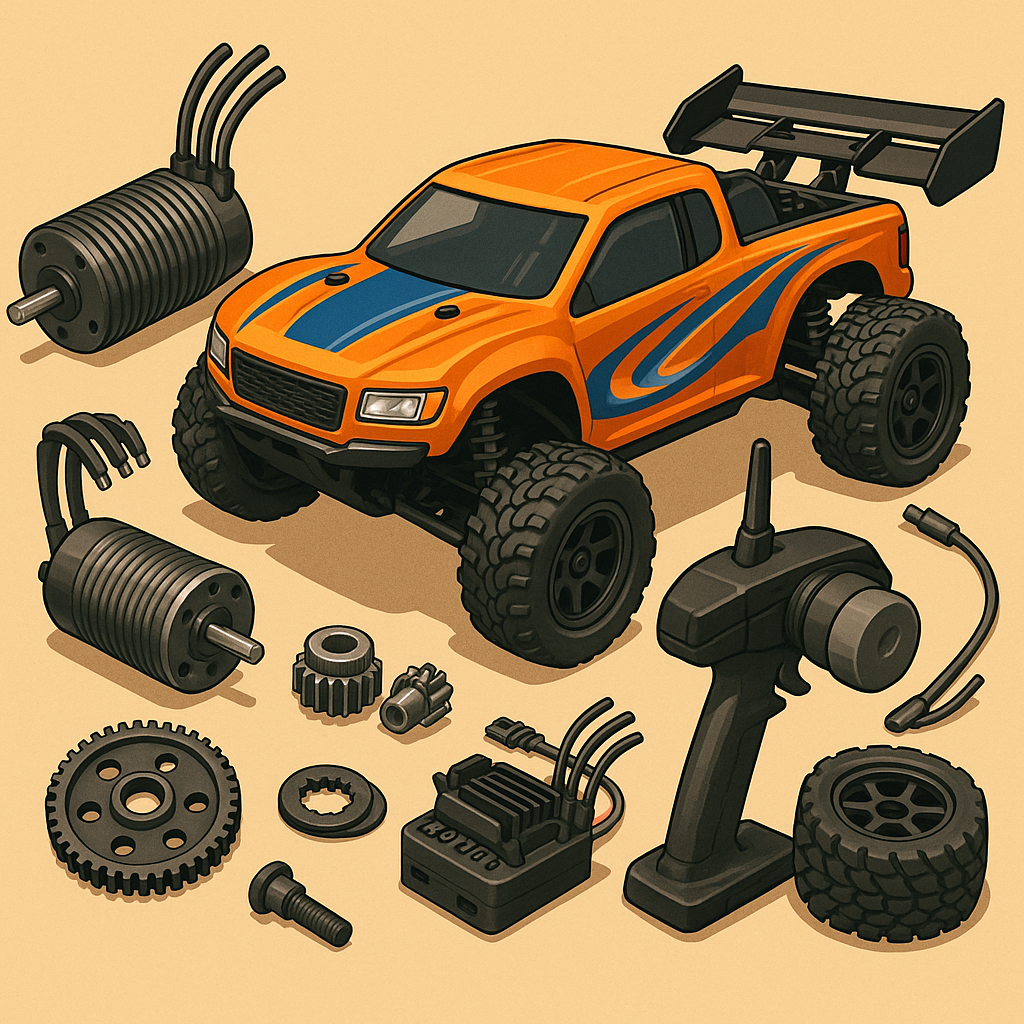
 RC Car Tips and Tricks for Hobbyists: Gearing, Brushless Motors, Drift Tuning and Traction Control." />
RC Car Tips and Tricks for Hobbyists: Gearing, Brushless Motors, Drift Tuning and Traction Control.
Getting the most from an RC car is as much about setup and small adjustments as it is about driving skill, and this guide collects practical tips for hobbyists who want better performance and control. I focus on four areas that make the biggest difference on track and at the skatepark: gearing, brushless motors, drift tuning and traction control. Read each section and try one change at a time so you can feel the difference in handling and power delivery.
Gearing is the simplest way to change acceleration and top speed, and understanding the spur and pinion relationship will save you time and broken parts. A higher pinion tooth count increases top speed but reduces acceleration and puts more load on the motor and ESC, while a smaller pinion gives stronger acceleration and cooler running but lowers top speed. Calculate the ratio by dividing spur teeth by pinion teeth and then consider your motor KV and battery voltage to estimate wheel RPM, as that helps you choose gearing that keeps the motor within its efficient range. Always check gear mesh is snug but not tight, run a dab of threadlock on grub screws where appropriate, and keep spare pinions and a small file in your pit box for quick repairs.
Brushless motors brought a massive step up in efficiency and longevity, but their performance depends on matching motor KV to your gearing, battery and ESC capabilities. Lower KV motors produce more torque and suit tighter tracks or heavier cars, while higher KV motors deliver higher top speed on long straights when paired with appropriate gearing and high discharge LiPo packs. Choose sensored motors if you want smoother low-speed control for drifting or precise slow manoeuvres, and sensorless motors if you prefer a simpler and often cheaper setup for racing. Don’t forget to set motor timing and ESC punch carefully to balance heat and power, and use cooling fans or heatsinks to protect bearings and magnets during hot sessions.
Drift tuning is a distinct discipline where traction is intentionally reduced and steering is maximised, so tyres, suspension and differential settings differ from grip racing. Fit slick or compound tyres suited to drift surfaces and raise tyre pressures or foam inserts to reduce grip if necessary, and tune rear toe and camber so the rear slips predictably rather than snaps violently. Use a looser centre diff or lighter diff oil to allow more slip, and consider a slipper clutch tuned to the surface so the drive train can break traction smoothly on power. Throttle curves, punch control and a good steering servo with endpoint adjustment are essential to maintain long slides, and small ballast adjustments can help balance nose or tail slide characteristics depending on your chassis layout.
Traction control can be mechanical or electronic, and a sensible combination of both will keep you faster over a variety of surfaces. Mechanically, choose suitable shock settings and swaybar stiffness to keep tyres planted through corners, and match diff oil weight to the grip level for predictable breakaway. Electronically, many modern ESCs offer adjustable traction control, throttle curves and drag brake, which are invaluable for tuning to changing conditions during a session. Keep a simple checklist in your pit bag for quick setup changes and regular maintenance tasks, and for downloadable setup sheets and more build notes visit WatDaFeck.
Comments
Post a Comment